Showing posts with label Word. Show all posts

Monday, August 8, 2016

Serving the Word

One of our congregation’s greatest gifts and treasures is our most senior deacon, and African-American brother in his eighties who describes himself as a “preaching deacon.” Before I came ten years ago, he filled the pulpit with the Word of God and kept the congregation spiritually fed and alive by the power of the Holy Spirit. We are all indebted to him, and honor him as one with “a high standing and great confidence in the faith that is in Christ Jesus” (1 Timothy 3:13). I have been blessed to know deacons who were faithful Sunday School teachers to both children and adults, men I respected not because of their ability to manage the “business” of the Church, but because they were servant-leaders in the Word. There are several passages in the Bible that I cannot read to this day without remembering a phone call from a deacon asking me for input on interpreting or applying a specific verse. We are a few weeks away from ordaining two men to our congregation's diaconate, and I am deeply thankful for their willingness to preach and teach the Word when asked.

While I know some who are not convinced, it has been generally accepted that the Seven of Acts 6 were either the first to hold the office “deacon,” or were predecessors to the office. “Now at this time while the disciples were increasing in number, a complaint arose on the part of the Hellenistic Jews against the native Hebrews, because their widows were being overlooked in the daily serving [τῇ διακονίᾳ] of food. So the twelve summoned the congregation of the disciples and said, ‘It is not desirable for us to neglect the word of God in order to serve [διακονεῖν] tables. Therefore, brethren, select from among you seven men of good reputation, full of the Spirit and of wisdom, whom we may put in charge of this task. But we will devote ourselves to prayer and to the ministry [τῇ διακονίᾳ] of the word.’ The statement found approval with the whole congregation; and they chose Stephen, a man full of faith and of the Holy Spirit, and Philip, Prochorus, Nicanor, Timon, Parmenas and Nicolas, a proselyte from Antioch. And these they brought before the apostles; and after praying, they laid their hands on them. The word of God kept on spreading; and the number of the disciples continued to increase greatly in Jerusalem, and a great many of the priests were becoming obedient to the faith” (Acts 6:1-7). Beyond this narrative, we have very little to tell us what those who hold the office of deacon (Philippians 1:1; 1 Timothy 3:8-13) did. What we do know is that the Seven of Acts 6 didn’t stick to serving tables. Stephen preaches in Acts 7 and becomes the first martyr of the new covenant people. Philip, the second of the Seven named, becomes a prominent “missionary” (a word not used in the N.T.) in Acts 8.[1] These servant-leaders, “men of good reputation, full of the Spirit and of wisdom,” met the physical needs of those in the congregation who needed assistance, but were also instrumental in the “spreading” of “the word of God.”

“[The ascended Christ] gave some as apostles, and some as prophets, and some as evangelists, and some as pastors and teachers, for the equipping of the saints for the work of service [ἔργον διακονίας]” (Ephesians 4:11,12). Christ gives pastor-teachers to His Church so that, by their efforts, all members of the congregation may become servants/ministers/deacons.[2] Those who hold the office of deacon serve as exemplars of what all the membership should work to be.

E. Earle Ellis (1926-2010) argues that “the diakonoi appear to be a special class of co-workers, those who are active in preaching and teaching.”[3] He gives plenty of examples of διάκονος being used in conjunction with the proclamation/exclamation of God’s Word:
·         “According to Eph 3,7f. Paul was made a diakonos according to the gift of grace, i.e. the grace to ‘preach the gospel to the Gentiles…similarly, Col 1,23.”[4]
·         “In contrast to their opponents in Corinth Paul and his companions, diakonoi of the new covenant, did not ‘peddle’ or ‘falsify’ the word of God (2Cor 2,17; 4,2) but rather accepted pay (ὀψώνιον) from other churches ‘for diakonia to you’, i.e. to preach the gospel to them (2Cor 11,8,7).”[5]
·         “In contrast to false ‘teachers,’ Timothy is to endure suffering, do the work (ἔργον) of an evangelist and (thus) fulfill his diakonia (2Tim 4,3ff.); here the term appears to include preaching and teaching (διδαχή, 4,2) generally.”[6]
·         “The congregational diakonoi are not to be ‘double-talkers’ (διλόγους) and are to hold to the ‘mystery of the faith’ with a clear conscience (1 Tim 3,8f; cf. Polyc 5,2) – the latter almost certainly refers to a teaching function.”[7]
·         “The close association with diakonos = teacher of the word of God may be inferred from 2Cor 3,6; 4,1,2,5…”[8]

The day is coming, and I believe now is, that the Church needs fewer administrating “boards” and more servant-leaders speaking the Word of God while they organize the congregation to meet the physical needs of those with needs in the membership. The pastor-teachers instruct in the Word, the deacons serve as exemplars of speaking and living the Word, and all the congregation speak the Word as they live in obedience to it in the world. After giving the qualifications for the offices of overseer and deacon, Paul explains that he wrote this “so that you will know how one ought to conduct himself in the household of God, which is the church of the living God, the pillar and support of the truth” (1 Timothy 3:15). The offices are inseparably linked to the purpose of the Church (its membership), which is to be the foundation on which the Word is made visible to the world for the glory and Kingdom of God.


[1] This is not the Philip who was one of the Twelve (Matthew 10:3//Mark 3:18//Luke 6:14; John 1:43-48; 6:5,7; 12:21,22; 14:8,9), since the “apostles” did not scatter with Saul’s persecution (Acts 8:1).
[2] I’m not arguing for the undoing of the office of “pastor-teacher,” or that all should become teachers (James 3). Teaching and proclaiming the Word you’ve been taught are not necessarily the same. All believers should speak the truth of the Word, and Christ gives His Church pastor-teachers to prepare them for that life of speaking.
[3] Prophecy & Hermeneutic in Early Christianity (Eugene, OR: Wipf & Stock, 2003), 9.
[4] Ibid., 9.29.
[5] Ibid., 8.
[6] Ibid., 9n29.
[7] Ibid., 9n31.
[8] Ibid., 11n38.

Thursday, September 17, 2015

The Mediator's Grace in Our Darkness

“‘Simon, Simon, behold, Satan [a Hebrew title meaning, “adversary”] has demanded permission to sift you like wheat; but I have prayed for you, that your faith may not fail; and you, when once you have turned again, strengthen your brothers.’ But he said to Him, ‘Lord, with You I am ready to go both to prison and to death!’ And He said, "I say to you, Peter, the rooster will not crow today until you have denied three times that you know Me’” (Luke 22:31-34).

The absolute sovereignty of God the Son, especially in the day of His suffering, is something we should not take for granted or overlook in the great drama of the narrative. Though Jesus tells “the chief priests and officers of the temple and elders” that “hour and the power of darkness” (22:53) belongs to them, He is still in total mastery of the moment. He has not laid that lordship down. In fact, as He is at the right hand of the Father, He has been given “all authority...in heaven and on earth” (Matthew 28:18). I need this reality as both my foundation and covering every day. So do you.

It’s not this sovereignty, though, that has astounded me afresh this week. I’ve been blessed and – yes – amazed at the grace that comes through the mediation of the great High Priest Jesus Christ.

The adversary, as he did with Job and does with innumerable saints, has demanded the right to test Peter’s faith. This is what he exists to do to the glory of God. “...the Satan’s job, as God’s submissive opposition, is to search men and women to see if there is anyone who is genuinely godly and pious...Satan has a ministry; it is the ministry of opposition, the ministry of insisting that the genuineness of the believer be tested and proved genuine. It is a hostile and malicious ministry, but a necessary ministry for the glory of God...the apostles are to be sifted by Satan, to see if their faith is genuine. And their faith will prove genuine, not least because God the Son prays to God the Father for Peter, and then Peter becomes the instrument to strengthen the faith of the others.”[1]

Peter’s betrayal, the arrest, and the adversary’s sifting of the Lord’s disciples, are all serving the Triune God to His ultimate glory. In every moment.

I taught from this “sifting” passage last month during a memorial service for a death I knew would be a trial to many believers, "so that no advantage would be taken of us by Satan, for we are not ignorant of his schemes" (2 Corinthians 2:11). We need to be aware of what is happening to us and through us in the darkness. Scripture alone reveals this to us.

The adversary must still ask for permission from the Lord to test believers. Just as we see with Job, the Lord defines the exact parameters for the sifting operation of the adversary. Jesus doesn’t tell Peter that the adversary’s request has been denied. The “one mediator also between God and men, the man Christ Jesus” (1 Timothy 2:5) has prayed that Peter’s “faith may not fail; and you, when once you have turned again, strengthen your brothers.” He doesn’t pray for Peter’s comfort, ease, health, wealth, or anything Peter himself might request. He prays for that which is eternally and salvifically important – Peter’s persistent faith. Peter benefits from this, of course (and still is, and always will), but the goal is the Church: “...strengthen your brothers.” It’s about Jesus loving His Church. He intercedes for the saints to the benefit of the saints not for the individual but for the Body.

Peter betrays Jesus three times, just as Jesus foretold (22:54-60). What happens at the end of this narrative is what I want us to see.

There are only two times in Luke-Acts where “the word of the Lord” is “remembered.” At both times Peter is the one remembering, and the difference between the two circumstances is the beautiful testimony to the glory of God’s grace in Jesus Christ.

After Peter denies the Lord three times, “the Lord turned and looked at Peter. And Peter remembered the word of the Lord, how He had told him, ‘Before a rooster crows today, you will deny Me three times.’ And he went out and wept bitterly” (22:61,62). The Lord’s word is verified, and Peter is utterly broken. It is “the sorrow that is according to the will of God produces a repentance without regret, leading to salvation, but the sorrow of the world produces death” (2 Corinthians 7:10). It is not comfortable, fun, or exalting (by prideful or worldly standards). But this is the “will of God” achieved through the mediation of the Son. Remembering the Word of Christ in the midst of sin results here in brokenness and repentance which leads to (because of the mediatiorial prayer of the Son) salvation by unwavering faith. This is the first time “the word of the Lord” is “remembered” by Peter in Luke-Acts. It’s a great statement of grace. After all, Jesus taught the disciples, “he who denies Me before men will be denied before the angels of God” (12:9). The only thing that can save Peter is grace, and that is abundant through Jesus Christ. Soli gratia.

As marvelous as that event of “remembering...the word of the Lord” is, the second is even greater. Peter has returned to Jerusalem after seeing God bring salvation to Cornelius’ house through the preaching of Christ. This is a new thing; the new covenant Church began out of Jerusalem among the Jewish people. Though Jesus hinted and clearly proclaimed numerous times that it would overflow these ethnic boundaries unto the ends of the earth, it’s still a shock to the Jewish Christians. So Peter addresses the Church in Jerusalem: “...Peter began speaking and proceeded to explain to them in orderly sequence, saying, ‘...I remembered the word of the Lord, how He used to say, “John baptized with water, but you will be baptized with the Holy Spirit.” Therefore if God gave to them the same gift as He gave to us also after believing in the Lord Jesus Christ, who was I that I could stand in God's way?”’” (Acts 11:4,16,17).

The second time Peter “remembered the word of the Lord” it resulted in this: “When they heard this, they quieted down and glorified God, saying, ‘Well then, God has granted to the Gentiles also the repentance that leads to life’” (11:18).

God is glorified, and the Kingdom of God begins its unstoppable spread through the world and all generations.[2]

Behold the grace of God: the first time Peter remembers the word of the Lord, it brings him to bitter tears; the second time Peter remembers the word of the Lord, it is as he is being used to bring salvation to the nations.

Jesus is still praying for His people:
  • “Christ Jesus is He Who died, yes, rather Who was raised, Who is at the right hand of God, Who also intercedes for us” (Romans 8:34).[3]
  • “...Jesus...because He continues forever, holds His priesthood permanently. Therefore He is able also to save forever those who draw near to God through Him, since He always lives to make intercession for them. For it was fitting for us to have such a high priest, holy, innocent, undefiled, separated from sinners and exalted above the heavens” (Hebrews 8:24-26).

It is the same prayer. We are sifted in this world to show our faith to be true. Peter, who learned this lesson recorded for this long age in the pages of holy Writ, teaches this principle to us in his first letter: “In this you greatly rejoice, even though now for a little while, if necessary, you have been distressed by various trials, so that the proof of your faith, being more precious than gold which is perishable, even though tested by fire, may be found to result in praise and glory and honor at the revelation of Jesus Christ” (1 Peter 1:6,7).

We are sifted and refined through the constant saving prayer of the heavenly High Priest, Who uses even the wicked adversary for our salvation and God’s ultimate glory. Also through His Word, we do not stand alone or for ourselves. As our faith is hardened into the unwavering might of the triumphant saint, we strengthen others, as well. By the Father’s grace through the mediation of the Son, the Church grows not just in spite of the adversary’s work, but instrumentally through it.

God is great, and His grace is amazing.
Rembrandt (1606-1669), The Denial of Saint Peter (1660)


[1] Christopher Ash, Job: The Wisdom of the Cross (Wheaton, IL: Crossway, 2014), 42,45,55.
[2] When we read the Kingdom parables of Jesus (and their roots in passages like Ezekiel 31:6; Daniel 4:21), this is the message: it starts small but spreads throughout the world.
[3] I was concerned with the “where” of the Holy Spirit in my last post. We should give attention, as well, to the “where” of the Son in our thinking, praying, singing, and theology. Without Him at the right hand of the Father, His continuing work as High Priest and Mediator is ignored. This is a serious problem, for it is from there that we “receive mercy and find grace to help in time of need” (Hebrews 4:16).

Friday, August 7, 2015

Pick Up the Book

Last night the first debate was held with candidates from the Republican Party for the 2016 presidential primaries. I did my best to not watch it, but ended up seeing the last hour before my bride and I settled down to watch “Alone” on the History Channel. She had an idea I appreciated: drop the candidates alone into the woods, and make them film themselves trying to survive. I might actually pay to watch that.

Anyway, I’ve been working on my contribution to our upcoming 3rd annual Southwest Bible Conference. Our theme this year is “the Sufficiency of Scripture.” The last question of last night’s debate was germane for our conference. One candidate gave a great answer. I won’t tell you who he was because I’m not interested in endorsing any candidate, but I’ll tell you he’s a fellow Southern Baptist and he’s not Mike Huckabee (even if you figure out who he is I’m still not endorsing him). When asked, “I want to know if any of them have received a word from God,” this candidate answered: “Well, I am blessed to receive a word from God every day in receiving the Scriptures and reading the Scriptures. And God speaks through the Bible.”

This was the most interesting part of a debate I really didn’t want to watch (I agree with a friend that these things start seeming like Saturday Night Live skits pretty quickly).

My immediate thought was, “I wish most other Southern Baptists could give an answer that spiritually mature and theologically accurate.”

Ah, beloved. Pick up the Book. Read by faith that the Author (God the Holy Spirit, 2 Timothy 3:16; 2 Peter 1:21) is present in you as a believer in the risen and glorified Jesus Christ (John 7:39; Acts 2:38). On every page He will teach you of that same Christ Who is your only Savior and Lord (Luke 24:44-49; John 5:39) to the glory of the Father. Even better – get together with some other believers and pick up the Book together. You don’t need impressions, special words, leadings, mystical guidance, curious feelings, horoscopes, inspiring psycho-babble from self-help life-coaches masquerading as preachers on the television or internet or bumper stickers, dreams, movements in your gut or heart or wherever, songs on the radio, faces on tortillas or toast, signs in the heavens or on the earth, advice from friends or celebrities, or anything else to hear from God.


Pick up the Book. This is how He speaks to His people.

Sunday, December 14, 2014

Gathering for Freedom

Our congregation’s worship leader sent me an e-mail last week describing several events going on this Lord’s Day. A community announcement in our little Southwest town invited people to “Happy Heathen Sunday,” a get-together by the “Atheist Meet-Up” group. Among other things, as this group gathers at a downtown coffee shop, they’ll “enjoy being terrible people who get to do what they like on Sunday morning.”

Sounds like freedom, doesn’t it? In opposition to the (maybe) 5% of the people in this city who will attend church this morning, these radical non-conformists will join the other 95% in following the dictates of their own desires. They’re only unique in that they’re being open and public about it. Are they really free, though?

Romans 6. Christian baptism denies their enjoyment is a reality. They may be doing “what they like,” but it’s the only thing they can do; not quite the libertine party they advertise it to be.

“...as many of us as were baptized into Christ Jesus were baptized into His death? Therefore we were buried with Him through baptism into death, that just as Christ was raised from the dead by the glory of the Father, even so we also should walk in newness of life. For if we have been united together in the likeness of His death, certainly we also shall be in the likeness of His resurrection, knowing this, that our old man was crucified with Him, that the body of sin might be done away with, that we should no longer be slaves of sin. For he who has died has been freed from sin” (Romans 6:3-7, N.K.J.V.).

“Slaves of sin,” needing to be “freed from sin.”

“...do not let sin reign in your mortal body, that you should obey it in its lusts” (6:12). Prior to baptism “into Christ Jesus,” sin reigned in the mortal body, and there was no option but to “obey it in its lusts.”

“...do not present your members as instruments of unrighteousness to sin” (6:13). Prior to baptism “into Christ Jesus,” there was no option but to “present your members as instruments of unrighteousness to sin.”

“Do you not know that to whom you present yourselves slaves to obey, you are that one’s slaves whom you obey, whether of sin leading to death, or of obedience leading to righteousness? But God be thanked that though you were slaves of sin, yet you obeyed from the heart that form of doctrine to which you were delivered. And having been set free from sin, you became slaves of righteousness...just as you presented your members as slaves of uncleanness, and of lawlessness leading to more lawlessness, so now present your members as slaves of righteousness for holiness...what fruit did you have then in the things of which you are now ashamed? For the end of those things is death. But now having been set free from sin, and having become slaves of God, you have your fruit to holiness, and the end, everlasting life. For the wages of sin is death, but the gift of God is eternal life in Christ Jesus our Lord” (6:16-19,21-23). Prior to baptism “into Christ Jesus,” nobody is free “to do what they like.” Well, let me clarify that. They are totally free “to do what they like,” as long as it’s “uncleanness,” “lawlessness,” and “sin.” We cannot pursue God’s “cleanness” apart from His Word (John 15:3) and baptism (Hebrews 10:22). Apart from Christ, we are not only breakers of God’s Law, but we hate God’s Law. Apart from Christ, we are “slaves to sin.” We can be nothing else.

On the Lord’s Day, grow in your knowledge of “that form of doctrine to which you were delivered.” Gather together with those who are “slaves of righteousness for holiness,” who are “slaves of God” bearing “fruit to holiness.” Gather with those “baptized into Christ Jesus.”

“Then Jesus said to those Jews who believed Him, ‘If you abide in My word, you are My disciples indeed. And you shall know the truth, and the truth shall make you free.’ They answered Him, ‘We are Abraham’s descendants, and have never been in bondage to anyone [see Exodus 13:3,14; 20:2; Deuteronomy 5:6; 6:12; 7:8; 8:14; 13:5,10; Judges 6:8; Micah 6:4]. How can You say, “You will be made free”?’ Jesus answered them, ‘Most assuredly, I say to you, whoever commits sin is a slave of sin. And a slave does not abide in the house forever, but a son abides forever. Therefore if the Son makes you free, you shall be free indeed” (John 8:31-36).

How does the Son make us “free”? By the abiding “in [Christ’s] word” as His “disciples indeed.” Gather together in the Word.

One of the first Christian books I read was Chuck Colson’s The Body (Word Publishing, 1992). It took a while for the message of the book to sink in, but as I’ve read it repeatedly over the last few decades, I’ve come to love it more and more. I wish I would’ve grabbed on to its theme sooner. There’s a passage in the book where a former Soviet citizen describes the efforts to erase God and her reaction to these efforts (pg. 76):

Today Irina was wondering, as she often had, why the teacher even bothered with the truckloads of words she was dumping from the front of the room. “God doesn’t exist,” the instructor said again. “Only silly old women believe in Him.”

Can’t they tell they are giving themselves away? thought Irina. Adults tell you there are no gremlins or ghosts. They tell you once or twice, that’s it. But with God, they tell you over and over again. So He must exist – and He must be very powerful for them to fear Him so greatly.

The Psalmist points this out, as well: “All his thoughts are, ‘there is no God’” (10:4, N.A.S.B.). This confession must be so constantly repeated because its assertion is counter to the way any part of the creation behaves. “...since the creation of the world His invisible attributes are clearly seen, being understood by the things that are made, even His eternal power and Godhead” (Romans 1:20, N.K.J.V.). “The things that are made” include the human brain, which is why Paul also says in the following verse that even idolaters and atheists “knew God.” They are “suppressing the truth in unrighteousness, because what may be known of God is manifest in them” (1:18,19). The work of the atheist is constant and never done, because it is a continual denial of the reality hard-wired into their very being. Must be exhausting. Especially when you must live up to the advertisement and “enjoy” your gathering under this banner.

I’m glad they made the announcement, and I absolutely support their freedom to gather and say whatever they want to say. I would never take it away from them or support anyone who desired to do so. In fact, they are being exceedingly helpful to the Gospel cause. They are conformists to the uttermost, since the vast majority of the population will be doing exactly what they are doing, be they confessing Christians or not. Most will spend this Sunday morning doing whatever they feel like doing, whatever they perceive will bring them the most enjoyment. The “happy” atheists are just being open and honest about it, reminding all who do obey the Scriptures’ command to gather for Christ’s glory on this third Sunday of Advent that our little town is a vital mission field. The self-described “heathen” are a God-given catalyst to prompt us to prayer and even greater efforts at evangelistic outreach to our neighbors, friends, and maybe even church members who get around to the Gathering if there’s nothing better to do on their plate.

And part of me, that part I’m not too sure about (he’s a weird mix of orneriness and zeal for the house of God), thinks, “I’ll wonder how long it would take to overwhelming outnumber the public atheistic gatherings in coffeehouses with Bible studies planted and supported by local churches?”

Not long, I suspect. Maybe it’s time to find out.


Gather, Church, this third Sunday of Advent, and rejoice in the coming of God to earth...then become a signpost pointing to this utterly unique and saving act by going out to be light in the darkness of your city.
Ormoc City, Leyte, Philippines (May 2014)

Friday, November 14, 2014

Image of God and Dominion

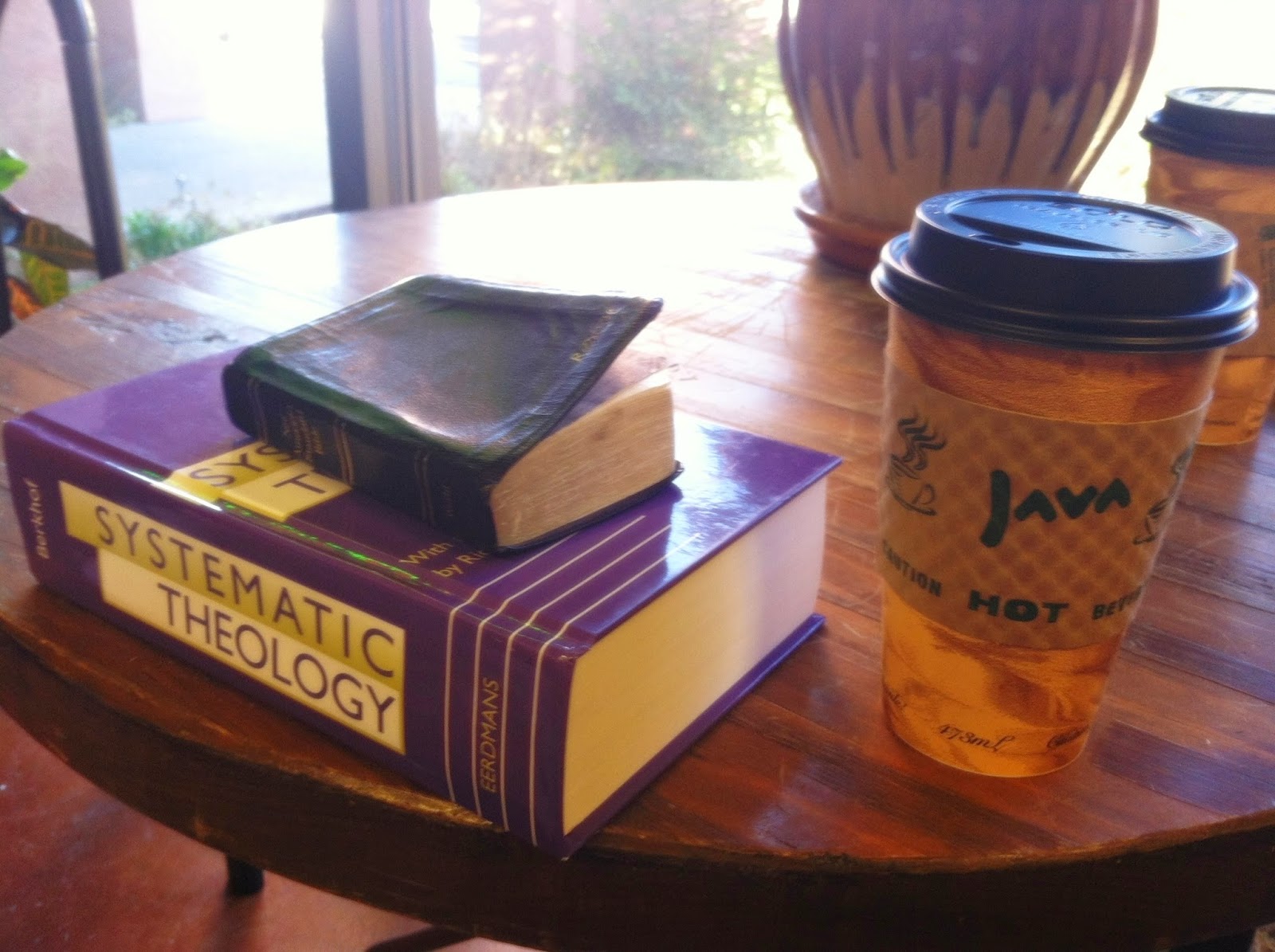
I meet Thursdays with a small group of men at a local coffee shop to discuss Louis Berkhof’s Systematic Theology (1939). Last week we read the section on the image of God (imago Dei) in human beings. I was just a little irked that the Dutchman was very reluctant concerning the view that I personally hold: the image of God in man is primarily the dominion he was to hold over all creation.

He started out in his historical summary of the doctrine: “The Socinians and some of the earlier Arminians taught that the image of God consisted only in man’s dominion over the lower creation” (pg. 203). Yeah, I didn’t appreciate being lumped in with these guys.

Later, Berkhof – still seeming reluctant – discusses the reasoning why dominion is considered a possible aspect of the image Dei: “There is considerable difference of opinion as to whether man’s dominion over the lower creation also formed a part of the image of God. This is not surprising in view of the fact that Scripture does not express itself explicitly on this point. Some regard the dominion in question simply as an office conferred on man, and not as a part of the image. But notice that God mentions man’s creation in the divine image and his dominion over the lower creation in a single breath, Gen. 1:26. It is indicative of the glory and honour with which man is crowned, Ps. 8:5,6” (pg. 205). Honestly, the fact that the imago Dei and dominion are mentioned in the same God-breath should mean that the issue is profoundly settled, and that any discussion of the topic ought to start here and only very reluctantly leave! I’ll return to this in a moment, but I seriously wonder how Berkhof can say “that Scripture does not express itself explicitly on this point”?!

“To sum up it may be said that the image consists: (a) In the soul or spirit of man, that is, in the qualities of simplicity, spirituality, invisibility, and immortality. (b) In the psychical powers or faculties of man as a rational and moral being, namely, the intellect and the will with their functions. (c) In the intellectual and moral integrity of man’s nature, revealing itself in true knowledge, righteousness, and holiness, Eph. 4:24; Col. 3:10. (d) In the body, not as a material substance, but as the fit organ of the soul, sharing its immortality; and as the instrument through which man can exercise dominion over the lower creation. (e) In man’s dominion over the earth. In opposition to the Socinians, some Reformed scholars went too far in the opposite direction, when they regarded this dominion as something that did not belong to the image at all but was the result of a special disposal of God” (pg. 207). Berkhof himself seems to have been influenced by this going “too far,” but at least he included dominion in his summation.

I’m not saying that the imago Dei is limited solely to dominion (I think Berkhof does a good job covering the other possibilities and their biblical basis), but consider it to be the scripturally primary and foundational aspect.

In the dawning days of the new creation, the second Adam gives His spiritual children a “Great Commission” (the new covenant version of Genesis 1:28). It is framed by the dominion He holds as the Man in perfect reflection of God’s image (2 Corinthians 4:4; Colossians 1:15; Hebrews 1:3): “All authority has been given to Me in heaven and on earth. Go therefore and make disciples of all the nations, baptizing them in the name of the Father and the Son and the Holy Spirit, teaching them to observe all that I commanded you; and lo, I am with you always, even to the end of the age” (Matthew 28:18-20).

(By the way, the plural pronouns of Genesis 1:26 find their echo in the Trinitarian baptismal formula of Matthew 28:19 in the creation of a new humanity at the head of the new creation.)

Dominion is one of the foundational biblical principles behind the idea of “good news,” or Gospel: “How lovely on the mountains Are the feet of him who brings good news, Who announces peace And brings good news of happiness, Who announces salvation, And says to Zion, ‘Your God reigns!’” (Isaiah 52:7).

The imago Dei in the second Adam is manifested in His absolute authority over all of Creation. He is “the ruler of the kings of the earth” (Revelation 1:5), the One Who “overcame and sat down with [His] Father on His throne” (3:21), the One Who is named “King of kings and Lord of lords” (19:16), and is “the root and descendant of David” (the eschatological King, 22:16). Remember, too, that Jesus, sole authoritative Exegete of the Father (John 1:18), speaks constantly of “Kingdom” during His earthly ministry (something near 120 times!).

From the standpoint of a thoroughgoing biblical theology, dominion should be viewed as the chief aspect of the imago Dei. Humanity was to display the absolute sovereignty and reign of God on His eternal throne. We cannot think of ourselves without thinking of the King.

As I told the men last Thursday morning, the idea of the imago Dei is not just abstraction. Berkhof rightly touches on the moral/ethical implication when he says, “the doctrine of the image of God in man is of the greatest importance in theology, for that image is the expression of that which is most distinctive in man and in his relation to God” (pg. 206). He further points out that “the Bible represents murder as the destruction...of the image of God in man, Gen. 9:6” (pg. 205). I made the point to the men that how we define personhood and what our attitude is toward persons is determined largely by our doctrine of the imago Dei. What qualifies as “human” and how humans are to be treated is on the forefront of our society’s ethical identity crisis.

Well, that basically where it ended in the coffee shop the other day, but I’ve been thinking about it further since then, convinced that I was missing something obvious and more basic to the discussion. I think I found it today while splitting some firewood for kindling in the backyard this morning.

“Then God said, ‘Let Us make man in Our image, according to Our likeness; and let them rule...’” (Genesis 1:26).  Perhaps more foundational to the doctrine of imago Dei is not what it is, exactly, but the fact that it is fact as a result of the proclamation of God. There needs to be a logocentric point at the base level of any consideration of this doctrine, I would think. The creation of God’s image in humanity at creation and the new humanity in the new creation is Word-based. When we are Word-centered, thinking God’s thoughts after Him, seeking to obey what He has commanded, aligning our relationships according to His revealed will, and viewing everything by a Word-created worldview, we will most accurately embody the imago Dei in this life. Merely exercising dominion, having morality, self-aware intelligence, respect for our bodies, existing in community (Berkhof didn’t mention this one, but I’ve read it in later 20th century systematic theologies), or any other option in the discussion of this doctrine, are all worthless unless they grow out of the presence of Scripture alone. “God said” must be the ground of our self-understanding as the imago Dei. As the apostle Peter said, “you have been born again not of seed which is perishable but imperishable, that is, through the living and enduring word of God” (1 Peter 1:23). It comes through the Christian community: “...this is the word which was preached to you” (1:25). The imago Dei is the presence of that Word which is God’s.


The imago Dei is introduced by its ground, “God said,” not just in the Scripture, but in truth (for the “Word is truth,” John 17:17). It is not subject to our manipulation, our redefinition, our opinion, or our preferences.

Monday, September 29, 2014

Greater Than Gold

We were in the book of Numbers last night. Israel’s enemies hire Balaam to curse the covenant people. The pagan diviner shows a surprising dedication to the Word of God (greater than many who today claim to be among the faithful):
  • “Though Balak were to give me his house full of silver and gold, I could not do anything, either small or great, contrary to the command of the LORD my God” (22:18).
  • “Behold, I have come now to you! Am I able to speak anything at all? The word that God puts in my mouth, that I shall speak” (22:38).
  • “Must I not be careful to speak what the LORD puts in my mouth?” (23:12).
  • “Did I not tell you, ‘Whatever the LORD speaks, that I must do’?” (23:26).
  • “Though Balak were to give me his house full of silver and gold, I could not do anything contrary to the command of the LORD, either good or bad, of my own accord. What the LORD speaks, that I will speak” (24:13).

He had been given something greater than gold (23:5).

“The law of the LORD is perfect, restoring the soul;
The testimony of the LORD is sure, making wise the simple.
The precepts of the LORD are right, rejoicing the heart;
The commandment of the LORD is pure, enlightening the eyes.
The fear of the LORD is clean, enduring forever;
The judgments of the LORD are true; they are righteous altogether.
They are more desirable than gold, yes, than much fine gold;
Sweeter also than honey and the drippings of the honeycomb.
Moreover, by them Your servant is warned;
In keeping them there is great reward” (Psalm 19:7-11).


God give us the grace you gave the magus from the east (Numbers 23:7), not just for a moment, but now into eternity. Give us an unending knowledge of “the sacred writings which are able to give [us] the wisdom that leads to salvation through faith which is in Christ Jesus” (2 Timothy 3:15). Greater than gold, sweeter than honey...

Wednesday, July 2, 2014

New Covenant Promises in Our Homes

The promise of the new covenant is one of the most precious of the entire Bible: “‘Behold, days are coming,’ declares the LORD, ‘when I will make a new covenant with the house of Israel and with the house of Judah, not like the covenant which I made with their fathers in the day I took them by the hand to bring them out of the land of Egypt, My covenant which they broke, although I was a husband to them,’ declares the LORD. ‘But this is the covenant which I will make with the house of Israel after those days,’ declares the LORD, ‘I will put My law within them and on their heart I will write it; and I will be their God, and they shall be My people. They will not teach again, each man his neighbor and each man his brother, saying, “Know the LORD,” for they will all know Me, from the least of them to the greatest of them [only those who know Him will be in the covenant],’ declares the LORD, ‘for I will forgive their iniquity, and their sin I will remember no more’” (Jeremiah 31:31-34).

In the new covenant, He writes His Law on the heart of the covenant people (see also Deuteronomy 30:6,8; Proverbs 1:23; Ezekiel 36:26,27)! This promise is fulfilled in Christ (Hebrews 8:6-12; 9:15; 12:24), and proclaimed weekly at the Table of the Lord (Luke 22:20; 1 Corinthians 11:25).

His Law is on the hearts of those who are truly the covenant people. But it doesn’t stay there. Remember this other great promise: “It will come about after this that I will pour out My Spirit on all mankind; and your sons and daughters will prophesy, your old men will dream dreams, your young men will see visions. Even on the male and female servants I will pour out My Spirit in those days” (Joel 2:28,29//Acts 2:16-18). This promise is for all those who “repent” and are “baptized in the name of Jesus Christ for the forgiveness of your sins” (Acts 2:38).

The writing of the Law on the heart is parallel to the pouring out of the Spirit. The Word and Spirit cannot be separated. The presence of the Spirit is manifested by the presence of the Word in the heart. The Law, written on the heart of those in the new covenant by the Lord Himself, does not stay in the heart. The Spirit manifests His Word from the heart of the new covenant community members through “prophesy,” “dreams,” and “visions.” These three manifestations will not deviate in the slightest from the Word of God (or they show themselves to be of a different spirit that is not holy).

In the new covenant, the Lord Himself (through His Word/Law and Holy Spirit) works out obedience to His own command: “These words, which I am commanding you today, shall be on your heart. You shall teach them diligently to your sons and shall talk of them when you sit in your house and when you walk by the way and when you lie down and when you rise up. You shall bind them as a sign on your hand and they shall be as frontals on your forehead. You shall write them on the doorposts of your house and on your gates” (Deuteronomy 6:6-9). I just read this passage to my children last night (we are considering Q.42 of the Westminster Shorter Catechism this week). The Spirit-spoken “prophecy” is none other than the teaching “diligently to your sons” and the “talk...in your house...by the way.” The “dreams” and “visions” are the “talk of them...when you lie down and when you rise up.” This is the blessed man who delights "in the Law of the LORD," and this delight manifests in his "day and night" meditation (Psalm 1:1,2).

Don’t miss the fact that we are to teach our children not just any “words,” but “these words,” commanded by Moses: the Law of God. They will never know their need for Christ apart from “these words” (Galatians 3:22-24). At the same time, don’t miss the fact that you cannot “teach them diligently,” “talk of them,” “bind them,” or “write them” apart from the Holy Spirit, Who speaks His Word/Law from the hearts of those who are the new covenant community in Christ.


“...be filled with the Spirit...fathers, do not provoke your children to anger, but bring them up in the discipline and instruction of the Lord” (Ephesians 5:18; 6:4). The instruction to our children of the Law of God in the power and help of the Holy Spirit in Christ is His great means of grace in our homes.

Monday, March 24, 2014

The Deeper Things Behind Spring Fever

Believe it or not, even we desert rats get “spring fever.” Even when spring brings words like dry, brown, dusty, and WIND (which must be capitalized...you know why if you’ve ever experienced it). I want to hit the trails and run. Partly because it’s warmer outside and I like the warmth, but also because it’s Monday. Monday’s the day I start work on the sermon for the following Sunday, and I’m preaching through Genesis 1 right now.

I love what our Creator has made, and I love being out in it. Before dawn this morning I started sermon prep the way I always do when I’m preaching from the Old Testament – I make sure I’m looking at Jesus, because I don’t want to miss Him.

Now that I think about it, this is true when reading the Old Testament or when reading the revelation of nature. I don’t want to miss the point while staring at the Word right in front of me.

So, before dawn, I re-read the text of Genesis and reminded myself that Creation is Trinitarian. This is the full depth of its glory.

“...there is but one God, the Father, from Whom are all things and we exist for Him” (1 Corinthians 8:6). God the Creator is God the Father. Out my early morning window Ursa Minor slowly crawls the sky...most mornings of the year I look out over the cup of coffee I hold near my beard and think, “my Father Who is in heaven put that there...and I’m thankful!”

But it’s not just the Father. God is one, but He is three Persons. The Son Whose earthly life earned my justification and Whose death paid my debt is the very Word by which all this beautiful creation has been made. “...God said...” (10 times in Genesis 1!). This is the only Savior of lost humanity, the King of kings and Lord of lords Who has all authority in heaven and on earth. He is the Word of creation. He is the eternal God the Son Who is one God with the Father but is not the Father. He is the Son.

“In the beginning was the Word, and the Word was with God, and the Word was God. He was in the beginning with God. All things came into being through Him, and apart from Him nothing came into being that has come into being” (John 1:1-3)

“For [the Father] rescued us from the domain of darkness, and transferred us to the kingdom of His beloved Son, in Whom we have redemption, the forgiveness of sins. He is the image of the invisible God, the firstborn [a statement of authority – see Psalm 89:27] of all creation. For by Him all things were created, both in the heavens and on earth, visible and invisible, whether thrones or dominions or rulers or authorities - all things have been created through Him and for Him. He is before all things, and in Him all things hold together” (Colossians 1:13-17).

“God, after He spoke long ago to the fathers in the prophets in many portions and in many ways, in these last days has spoken to us in His Son, Whom He appointed heir of all things, through Whom also He made the world. And He is the radiance of His glory and the exact representation of His nature, and upholds all things by the word of His power” (Hebrews 1:1-3).

The Creation moves me to praise this Son Who is the Word of Creation.

God the Holy Spirit is there, too. “...the Spirit of God was moving over the surface of the waters” (Genesis 1:2). He is the breath of God Who brings the Word forth to create out of nothing. We see them together in the song of the Psalmist: “By the word of the LORD the heavens were made, and by the breath of His mouth all their host” (33:6).

The Hebrew רוח (and the Greek πνευμα in the New Testament) is translated “Spirit,” “breath,” and “wind.” I think of that often in the desert springtime, when the wind threatens to carry us all off. A lot of folks here grumble about it, but I love it. I think of Him Who moves as He wills and brings the dead to life. We cannot see Him, but we certainly know His effects.

“Jesus answered, ‘Truly, truly, I say to you, unless one is born of water and the Spirit he cannot enter into the kingdom of God. That which is born of the flesh is flesh, and that which is born of the Spirit is spirit. Do not be amazed that I said to you, “You must be born again.” The wind blows where it wishes and you hear the sound of it, but do not know where it comes from and where it is going; so is everyone who is born of the Spirit’” (John 3:5-8). This is one of my favorite of Jesus’ illustrations – mainly because I’m a desert-dweller and I’ve known wind. (By the way, 3:5 is also a really cool allusion to Ecclesiates 11:5!)

Monday morning. Coffee. The beauty of the Creation. The Trinity. The full revelation of the Word of God.

And my salvation.

“The hand of the LORD was upon me, and He brought me out by the Spirit of the LORD and set me down in the middle of the valley; and it was full of bones. He caused me to pass among them round about, and behold, there were very many on the surface of the valley; and lo, they were very dry. He said to me, ‘Son of man, can these bones live?’ And I answered, ‘O Lord GOD, You know.’ Again He said to me, ‘Prophesy over these bones and say to them, “O dry bones, hear the word of the LORD.” Thus says the Lord GOD to these bones, “Behold, I will cause breath to enter you that you may come to life. I will put sinews on you, make flesh grow back on you, cover you with skin and put breath in you that you may come alive; and you will know that I am the LORD.”’ So I prophesied as I was commanded; and as I prophesied, there was a noise, and behold, a rattling; and the bones came together, bone to its bone. And I looked, and behold, sinews were on them, and flesh grew and skin covered them; but there was no breath in them. Then He said to me, ‘Prophesy to the breath, prophesy, son of man, and say to the breath, “Thus says the Lord GOD, ‘Come from the four winds, O breath, and breathe on these slain, that they come to life.’”’ So I prophesied as He commanded me, and the breath came into them, and they came to life and stood on their feet, an exceedingly great army” (Ezekiel 37:1-10; cf. James 1:18; 1 Peter 1:23-25)

By the will of God, His Word fills us with the Spirit and we live.


Spring fever. I love being outside. Even if “outside” is the desert in the springtime. As magnificently glorious as the creation is, it tells of an infinitely deeper and glorious Reality. One I look forward to enjoying with all my being forever and ever and ever...
Dust storm, July 2013

Thursday, March 20, 2014

Two Testimonies You Need to Hear Today, Church


“To our dear brothers in the church of Geneva: Grace and peace from our good God and Father through Jesus Christ our Savior be multiplied to you Amen!

Very dear brothers in our Lord Jesus Christ, since you have been informed of our captivity and of the fury which drives our enemies to persecute and afflict us, we felt it would be good to let you know of the liberty of our spirit and of the wonderful assistance and consolation which our good Father and Savior gives us in these dark prison cells, so that you may participate not only in our affliction of which you have heard but also in our consolation, as members of the same body who all participate in common both in the good and in the evil which comes to pass. For this reason we want you to know that although our body is confined here between four walls, yet our spirit has never been so free and so comforted, and has never previously contemplated so fully and so vividly as now the great heavenly riches and treasures and the truth of the promises which God has made to His children; so much so that we seem not only to believe and hope in them but even to see them with our eyes and touch them with our hands, so great and remarkable is the assistance from God in our bonds and imprisonment. So far, indeed, are we from wishing to regard our affliction as a curse from God, as the world and the flesh wish to regard it, that we regard it rather as the greatest blessing that has ever come upon us, for in it we are made true children of God, brothers and companions of Jesus Christ, the Son of God, and are conformed to His image; and by it the possession of our eternal inheritance is confirmed to us. Further, we are bold to say and affirm that we shall derive more profit in this school for our salvation than has ever been the case in any place where we have studied, and we testify that this is the true school of the children of God...we therefore praise God with all our heart and give Him undying thanks that He has been pleased to give us by His grace not only the theory of His Word but also the practice of it, and that He has granted us this honor – which is no small thing for vessels so poor and fragile and mere worms creeping on the earth – by bringing us out before men to be His witnesses and giving us constancy to confess His name and maintain the truth of His holy Word before those who are unwilling to hear it, indeed, who persecute it with all their force...we pray you most affectionately to thank our good God with us for granting to us so great a blessing, so that we may return thanks to Him, beseeching Him that, as He has commenced this work in us, so He will complete it, to the end that all glory may be given to Him, and that, whether we live or die, all may be to His honor and glory, to the edification of His poor Church, and to the advancement of our salvation. Amen.”

Sent by five young men imprisoned in Lyon (July 1552), from Philip E. Hughes’ The Register of the Company of Pastors of Geneva in the Time of Calvin (Eugene, OR: Wipf & Stock, 1966), pgs. 191-192.

They would be burned at the stake.

“Having made profession of the glorious gospel of Christ a long time, and preached the same about five years, I was apprehended at a meeting of good people in the country...at the sessions after I was indicted for an upholder and maintainer of unlawful assemblies and conventicles, and for not conforming to the national worship of the church of England; and after some conference there with the justices, they taking my plain dealing with them for a confession, as they termed it, of the indictment, did sentence me to a perpetual banishment, because I refused to conform. So being again delivered up to the jailer’s hands, I was had home to prison, and there have lain now complete twelve years, waiting to see what God would suffer these men to do with me. In which condition I have continued with much content, through grace, but have met with many turnings and goings upon my heart, both from the Lord, Satan, and my own corruptions; by all which (glory be to Jesus Christ) I have also received among many things, much conviction, instruction, and understanding, of which at large I shall not here discourse; only give you a hint or two, a word that may stir up the godly to bless God, and to pray for me; and also to take encouragement, should the case be their own – not to fear what man can do to them. I never had in all my life so great an inlet into the word of God as now...”


Written by John Bunyan, in his Grace Abounding to the Chief of Sinners (1666).

Monday, March 10, 2014

Ash Cake

“Then Jesus was led up by the Spirit into the wilderness to be tempted by the devil. And after fasting forty days and forty nights, He was hungry. And the tempter came and said to Him, ‘If you are the Son of God, command these stones to become loaves of bread.’ But He answered, ‘It is written [in Deuteronomy 8:3], “Man shall not live by bread alone, but by every word that comes from the mouth of God”’” (Matthew 4:1-4).

This hunger. It is purposeful. It is the lesson, the test.

“And you shall remember the whole way that the LORD your God has led you these forty years in the wilderness, that He might humble you, testing you to know what was in your heart, whether you would keep His commandments or not. And He humbled you and let you hunger and fed you with manna, which you did not know, nor did your fathers know, that He might make you know that man does not live by bread alone, but man lives by every word that comes from the mouth of the LORD” (Deuteronomy 8:2,3).

The Exodus generation failed it. The true Israel, Jesus of Nazareth, passed the test.

He then ascended the mountain, sat, and taught the disciples more about hunger and bread and the way of the Father between the two...

“Pray then like this: ‘Our Father in heaven...give us this day our daily bread...’” (Matthew 6:9-11).

“Ask, and it will be given to you; seek, and you will find; knock, and it will be opened to you. For everyone who asks receives, and the one who seeks finds, and to the one who knocks it will be opened. Or which one of you, if his son asks him for bread, will give him a stone? Or if he asks for a fish, will give him a serpent? If you then, who are evil, know how to give good gifts to your children, how much more will your Father Who is in heaven give good things to those who ask Him!” (Matthew 7:7-11).

Bread, bread, bread. Pray for it. Be thankful for the good gift of it.

But remember. Never forget. Your life does not come from the bread.

If you are focused on the bread, you’ll miss eternal life. Even if you’re eating that bread from the hand of the Son of God Himself, you’ll find yourself hungry in eternity.

One day the Lord fed 5,000 people bread. Bellies filled, they followed Him. The bread wasn’t enough for eternal life.

“Jesus answered them, ‘Truly, truly, I say to you, you are seeking Me, not because you saw signs, but because you ate your fill of the loaves. Do not labor for the food that perishes, but for the food that endures to eternal life, which the Son of Man will give to you. For on Him God the Father has set his seal’” (John 6:26,27).

Pray for the Word from the mouth of the Father. Be thankful for the good gift of it. It is bread that truly brings life, life, eternal life.

“Jesus then said to them, ‘Truly, truly, I say to you, it was not Moses who gave you the bread from heaven, but my Father gives you the true bread from heaven. For the bread of God is He Who comes down from heaven and gives life to the world...I am the bread of life; whoever comes to Me shall not hunger...I am the bread of life. Your fathers ate the manna in the wilderness, and they died. This is the bread that comes down from heaven, so that one may eat of it and not die. I am the living bread that came down from heaven. If anyone eats of this bread, he will live forever. And the bread that I will give for the life of the world is My flesh...as the living Father sent Me, and I live because of the Father, so whoever feeds on Me, he also will live because of Me. This is the bread that came down from heaven, not like the bread the fathers ate and died. Whoever feeds on this bread will live forever’” (John 6:32,33,35,48-51,57,58).

Hungry? Where are you going to go?

“After this many of His disciples turned back and no longer walked with Him. So Jesus said to the Twelve, ‘Do you want to go away as well?’ Simon Peter answered Him, ‘Lord, to whom shall we go? You have the words of eternal life, and we have believed, and have come to know, that You are the Holy One of God’” (John 6:66-69).


Seek this bread.

Saturday, January 25, 2014

The Sword of Jesus

Biblical, Christ-centered preaching is Christ’s own sword, which He wields to warn, correct, and judge both His Church and the world. The theme of God’s striking Word is seen in the prophets:
  • “There shall come forth a shoot from the stump of Jesse, and a branch from his roots shall bear fruit. And the Spirit of the LORD shall rest upon Him, the Spirit of wisdom and understanding, the Spirit of counsel and might, the Spirit of knowledge and the fear of the LORD. And His delight shall be in the fear of the LORD. He shall not judge by what His eyes see, or decide disputes by what His ears hear, but with righteousness He shall judge the poor, and decide with equity for the meek of the earth; and He shall strike the earth with the rod of His mouth, and with the breath of His lips He shall kill the wicked” (Isaiah 11:1-4).
  • “‘Is not my Word like fire,’ declares the LORD, ‘and like a hammer that breaks the rock in pieces?’” (Jeremiah 23:29).

Does He do this directly in a literal manifestation of His Person? No. A passage in Hosea reveals to us how His sword is unsheathed to do its work: “Therefore I have hewn them by the prophets; I have slain them by the words of My mouth, and My judgment goes forth as the light” (6:5). The sword of the Word of God is present in the proclamation of that Word by God’s called emissaries.

His Word faithfully proclaimed in the power of the Holy Spirit produces the effects for which it is intended. “For as the rain and the snow come down from heaven and do not return there but water the earth, making it bring forth and sprout, giving seed to the sower and bread to the eater, so shall My Word be that goes out from My mouth; it shall not return to Me empty, but it shall accomplish that which I purpose, and shall succeed in the thing for which I sent it” (Isaiah 55:10,11). We often quote this verse, but don’t make the connection between the Word going forth from the mouth of God and the proclamation of that Word by God’s prophets/preachers.

Read Genesis 1. The very existence of Creation all around us (and including us) is a testimony to the power of God’s proclaimed Word. This is the power He manifests when His appointed prophets/preachers proclaim His Word. Preaching is a function of the will of the Spirit of God (1 Corinthians 12:28; Ephesians 4:11,12). If the first Creation was made by His Word alone, how much more the New Creation – and who has been called and empowered to proclaim His creating Word?

As an important aside:
  • I define “prophecy” as the act of applying the Word of God by the calling, guidance, and power of the Holy Spirit – what we do when we “preach” in the Church every Lord’s Day. I think the continuists and cessationist arguments are both off because we have allowed the modern Pentacostal/charismatic movements to define the terms “prophecy” and “tongues” (among others). The vast majority of what we see the Old Testament prophets doing was applying the Law (including the promised curses of invasion and exile) to their day by the power of the Holy Spirit. “Prophecy” is a term that emphasizes the Spirit’s involvement in preaching (applying the contextually-accurate, theologically-orthodox explained Word to the hearers in the gathering of the Church).
  • I do not mean that the off-topic, contextually-removed, theologically-bankrupt, humanistic, erring babbling of the man who refuses to be faithful to the Word and is not in submission to the Spirit is the sword of Christ. Just because someone has a title and stands on the stage before a crowd does not guarantee that his words are the Word. Our opinions, preferences, “special words,” “leadings,” experience, etc., are not the sword of the Spirit of Christ, which is the Word of God proclaimed by His power. Please don’t hear me say otherwise.

This is how Christ the King works through His Holy Spirit: in the reading, preaching, and teaching of the Word wherever the saints gather:
  • This sword convicts and disciplines true believers: “For the Word of God is living and active, sharper than any two-edged sword, piercing to the division of soul and of spirit, of joints and of marrow, and discerning the thoughts and intentions of the heart. And no creature is hidden from His sight, but all are naked and exposed to the eyes of Him to Whom we must give account” (Hebrews 4:12,13).
  • This sword is all we need against all the powers of darkness – human or spiritual – that oppose the reign of the King of kings over all the heavens and earth: “Finally, be strong in the Lord and in the strength of His might. Put on the whole armor of God, that you may be able to stand against the schemes of the devil. For we do not wrestle against flesh and blood, but against the rulers, against the authorities, against the cosmic powers over this present darkness, against the spiritual forces of evil in the heavenly places. Therefore take up the whole armor of God, that you may be able to withstand in the evil day, and having done all, to stand firm. Stand therefore...and take...the sword of the Spirit, which is the Word of God” (Ephesians 6:10-13,14,17).

The Revelation is a fitting conclusion to the Bible since it is put together by the Holy Spirit from all the other things the Spirit inspired in the rest of the Bible. There is not a phrase or image that isn’t echoing something that came before. Here we see “the sword of the Spirit, which is the Word of God,” inseparably connected with the glorified, reigning Jesus:
  • “Then I turned to see the voice that was speaking to me, and on turning I saw seven golden lampstands, and in the midst of the lampstands one like a son of man, clothed with a long robe and with a golden sash around His chest. The hairs of His head were white, like white wool, like snow. His eyes were like a flame of fire, His feet were like burnished bronze, refined in a furnace, and His voice was like the roar of many waters. In His right hand He held seven stars, from His mouth came a sharp two-edged sword, and His face was like the sun shining in full strength” (Revelation 1:12-16).
  • “And to the angel of the church in Pergamum write: ‘The words of Him Who has the sharp two-edged sword. I know where you dwell, where Satan’s throne is. Yet you hold fast My name, and you did not deny My faith even in the days of Antipas my faithful witness, who was killed among you, where Satan dwells. But I have a few things against you: you have some there who hold the teaching of Balaam, who taught Balak to put a stumbling block before the sons of Israel, so that they might eat food sacrificed to idols and practice sexual immorality. So also you have some who hold the teaching of the Nicolaitans. Therefore repent. If not, I will come to you soon and war against them with the sword of My mouth. He who has an ear, let him hear what the Spirit says to the churches’” (Revelation 2:12-17).
  • “Then I saw heaven opened, and behold, a white horse! The One sitting on it is called Faithful and True, and in righteousness He judges and makes war. His eyes are like a flame of fire, and on His head are many diadems, and He has a name written that no one knows but Himself. He is clothed in a robe dipped in blood, and the name by which He is called is The Word of God. And the armies of heaven, arrayed in fine linen, white and pure, were following Him on white horses. From His mouth comes a sharp sword with which to strike down the nations, and He will rule them with a rod of iron. He will tread the winepress of the fury of the wrath of God the Almighty” (Revelation 19:11-15).

Does Jesus have a two-edged sword literally, physically coming out of His mouth? No. Read these images in light of the rest of the New Testament, which clearly shows the Word going forth in power throughout the world, according to His will, by the power of His Holy Spirit, and through the Church.

“Behold! The ecclesiastical power which is given to pastors of the church (by whatever name they are called) is clearly declared! That is, by God’s Word which they are established to administer, they boldly dare all things and constrain every glory, greatness, and power of this world to obey and submit to the divine Majesty. By this Word they have command over the whole world; they build up Christ’s house and overturn Satan’s kingdom; they feed the sheep and kill the wolves; they lead by teaching and exhortations those who are teachable; they constrain and correct the rebellious and obstinate; they bind, loose, thunder, and cast lightning - but all in the Word of God” (John Calvin, 1541 edition of Institutes of the Christian Religion, 15).

As we go through these days in this world, our “righteous souls are tormented by the lawless deeds we see and hear” (to paraphrase 2 Peter 2:8). The days and weeks and months and years and decades seem long, and it seems that the forces of darkness are in easy, clear control of the world. It must’ve seemed so to Daniel, as well. But the message of that book is clear: despite the Nebuchadnezzars and Belshazzars and Babylons and scary beasts, God is absolutely, 100% in total control over all. The clashing of world powers is matched in the heavenlies by unseen (but far more powerful) forces that don’t fight for God in their own created strength, but by His unstoppable and perfect providential will. Let the Word direct your vision of the world – as it was during Daniel’s day, so it is today. The King of kings and Lord of lords has been given authority over all of heaven and earth. He has unsheathed His mighty sword – the Spirit-inspired Word, and wields it through the faithful proclamation of His Church in all places in all the centuries since His ascension. By it He defends where He will and defeats where He will, according to His perfect, sovereign plan. Read it with this truth in mind. Preach it, teach it, pray it with this truth in mind. Hear it and live by faith-based, Spirit-empowered obedience to its commands in your life. The Word is the Sword of Christ, and it does exactly what He wills it to do, both in your heart and mind, and on the vanity that is the world stage.

Biblical, Christ-centered preaching is Christ’s own sword, which He wields to warn, correct, and judge both His Church and the world.

All this being said, I feel I need to suggest something, and, in so doing, probably scuttle a reasonably edifying blog post.

Because of the principle I argued for above, I’ve often wondered if the events of Revelation 19:11-15 were actually descriptive of the events started at Pentecost: Jesus descending in His Holy Spirit (John 14:16-18; Romans 8:9; 1 Peter 1:11) to begin manifesting His reign and bringing judgment upon His enemies through the proclamation of the Word throughout the world (Acts 1:8; Colossians 1:23).

I’ve had the same thoughts about the Olivet Discourse (which is obviously about the destruction of the Temple in A.D. 70): “And He will send out [αποστελει] His angels [τους αγγελους, which can also be translated “messengers”] with a loud trumpet call, and they will gather His elect from the four winds, from one end of heaven to the other” (Matthew 24:31). Could this be the current Gospel Age, when Christ is gathering the elect from all over the world through His sent-out messengers?

I’m not denying a “literal, physical, visible return” of Christ. I’m saying that it’s very possible that the passages that we’ve traditionally thought taught this doctrine do not. Before you write me off (I mean that figuratively, not literally, physically, and visibly), read the Old Testament parallel to Matthew and Revelation’s “literal, physical, visible return” texts: 2 Samuel 22//Psalm 18. Now show me where anything even remotely like this happened in a “literal, physical, visible” sense in the historical narrative of 1-2 Samuel. Do the same with Deborah’s song (Judges 5:4,5,20). When did we see the coming of the Lord on march or see angels stoop to battle human beings in the historical narrative of the battle itself (4:1-24)?

I think we in the Church are long overdue for a revolution (I would’ve used “reformation,” but that’s been taken) in our eschatology. Rooting our reading of the New Testament more firmly in the way the Old Testament speaks while being purposefully aware of the historical context of the A.D. first century and the theological shift-of-age that happened then would make our eschatology smaller (but more potent) and more focused on the general thrust of the entire N.T.: Jesus is Lord of all, and He manifests His reign by the power of His Spirit through the proclamation of the Word throughout the world. May our reading of so-called eschatological passages lead us to the Great Commission (Matthew 28:18-20) rather than charts and today’s news.

There is a connection between the response to the proclamation of the Word of God and our eternity after the final judgment. Proclamation and eternal judgment are linked in the Word of God (Romans 10:8-17; 2 Thessalonians 1:7,8). Don't underemphasize or undervalue this great link. Preaching is a manifestation of the eschatological.

Preach the Word. We are Spirit-empowered heralds of the King Who – right now – reigns over heaven and earth and continues (as He has for almost 2,000 years) to powerfully manifest that reign through the proclamation of the Word through His Church.